Conversations Are Breaking for Growing Teams
For modern businesses, conversations are where decisions happen.
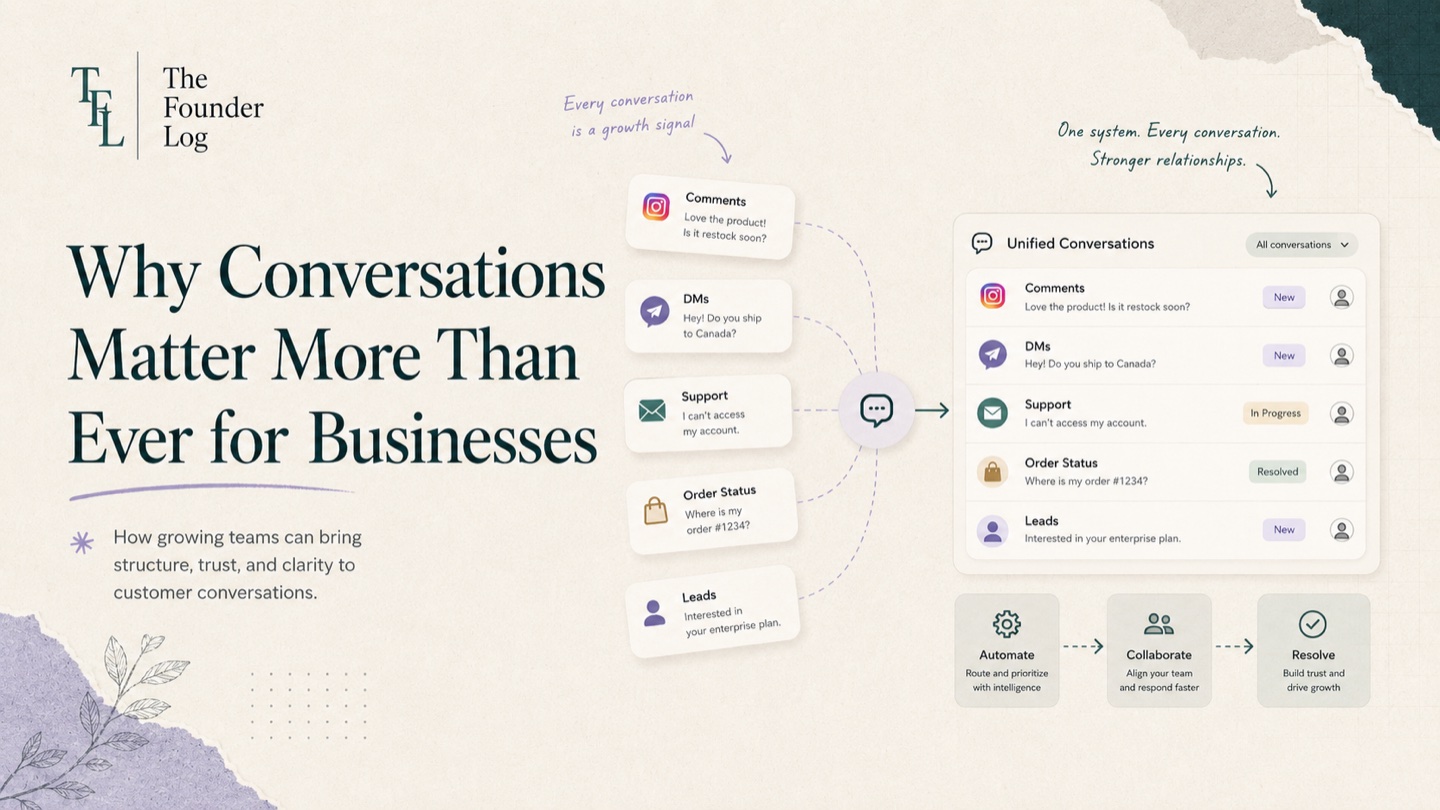
A customer may discover a product through a reel, ask for pricing in the comments, continue the conversation in DMs, and later expect order support on WhatsApp. What looks like a simple chat from the customer’s side often becomes a fragmented workflow for the business.
In the early stage, this may not feel like a major problem. One person can open Instagram, reply to comments, handle DMs, and remember important follow-ups. But as the number of customers, campaigns, and team members increases, the same workflow starts breaking down.
The issue is not that businesses are ignoring conversations. The issue is that most conversation channels were not designed for teams, accountability, automation, or scale.
A growing business needs more than an inbox. It needs a structured way to manage customer conversations.
1. Conversations are scattered across channels
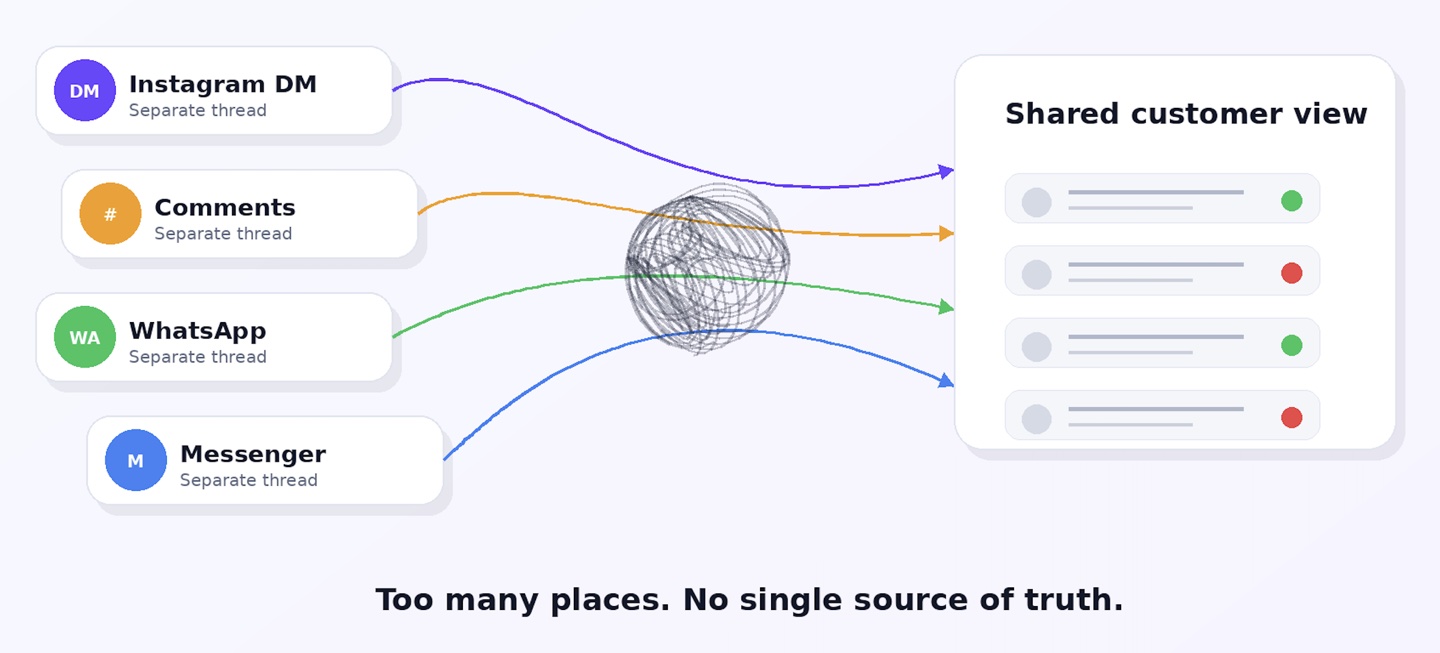
Customer conversations rarely stay in one place.
A potential buyer may comment “price?” on an Instagram reel. Another may send a DM asking for product availability. Someone else may follow up on WhatsApp after placing an order. A support request may come from a customer who already spoke to the team earlier through a different channel.
For the customer, this is one continuous journey.
For the business, it becomes scattered across multiple touchpoints.
When conversations are spread across comments, DMs, WhatsApp, and internal team discussions, it becomes difficult to track what has already happened. Teams may miss important messages, repeat the same questions, or lose context between one interaction and the next.
This creates friction for both sides. Customers expect quick, informed replies. Teams, however, are forced to search through different places just to understand the conversation.
As businesses grow, scattered communication becomes one of the biggest reasons for missed leads and poor customer experience.
2. Multi-agent teams create ownership problems
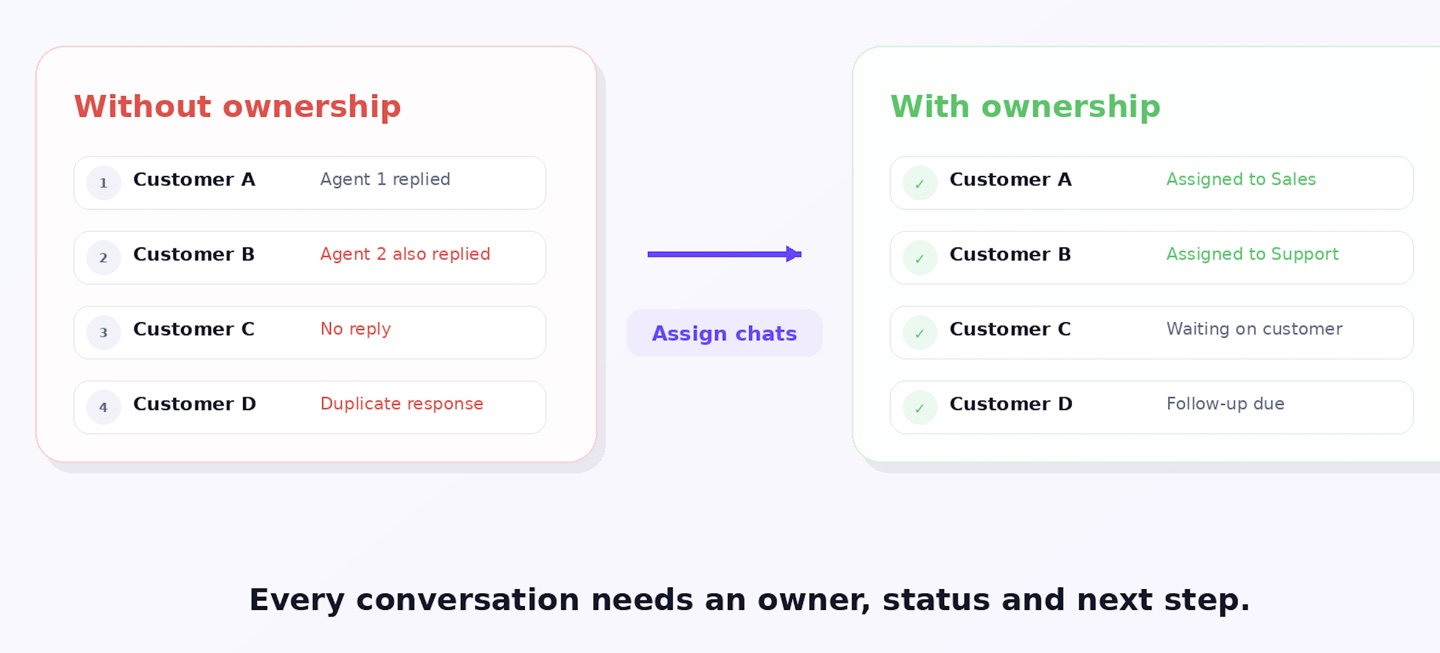
When only one person handles customer messages, ownership is clear.
But when multiple agents are involved, the inbox needs rules.
Without a proper system, two common problems appear. Either multiple agents reply to the same customer, or no one replies because everyone assumes someone else is handling it.
Both situations damage the customer experience.
Duplicate replies make the business look unorganized. Missed replies make the customer feel ignored. In sales conversations, even a small delay can lead to a lost buyer. In support conversations, lack of ownership can turn a simple issue into a complaint.
Growing teams need clear answers to basic questions:
Who is responsible for this chat?
Has the customer received a reply?
Is this conversation still open?
Does this need follow-up?
Should this go to sales, support, or operations?
Without clear ownership, the inbox becomes chaotic.
A business conversation should never depend on guesswork. Every chat needs an owner, a status, and a clear next step.
3. Shared credentials create a trust and security risk
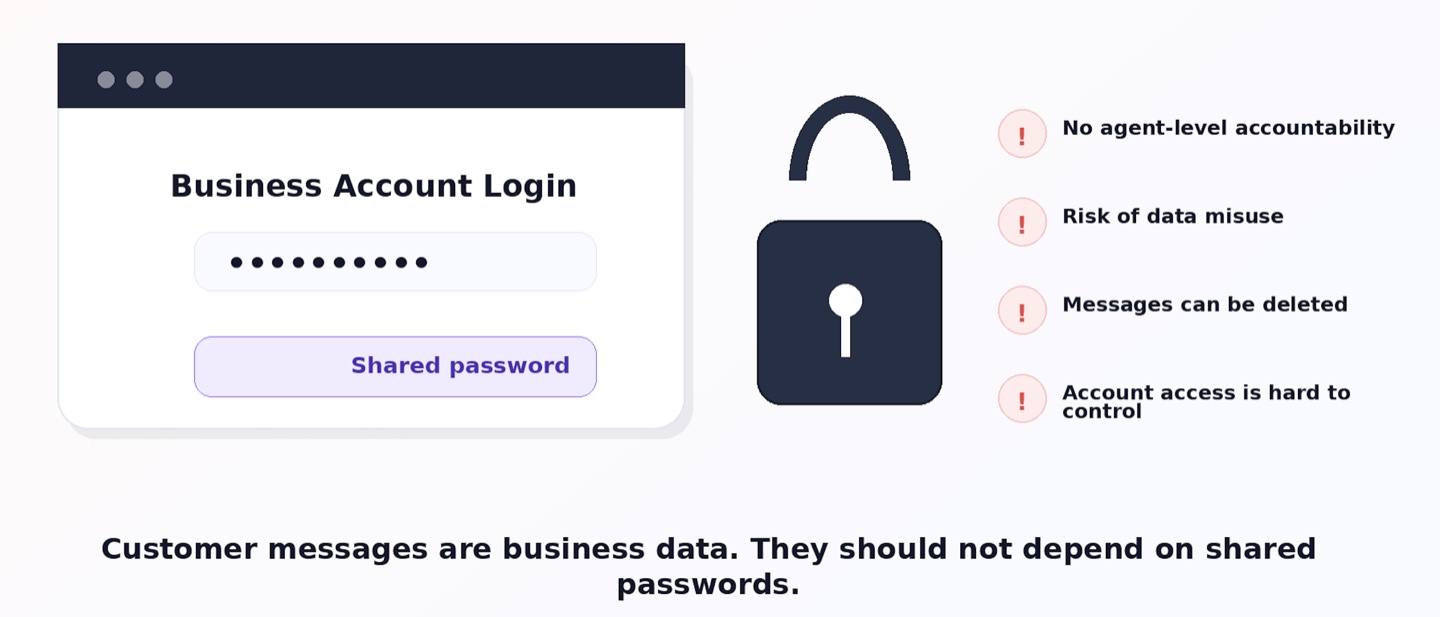
Many businesses solve team access in the simplest possible way: they share the main Instagram or WhatsApp credentials with team members.
This may feel convenient, but it creates serious problems.
When everyone logs in using the same account, there is no clear accountability. It becomes difficult to know who replied to a customer, who made a mistake, who missed a message, or who deleted a conversation.
This also creates risk when a team member leaves. The business has to change passwords, manage access again, and worry about whether sensitive customer conversations were exposed.
Customer conversations often contain important information: pricing discussions, order details, complaints, addresses, phone numbers, and purchase intent. These are not just casual messages. They are business data.
That data should not be managed through shared passwords.
A growing business needs controlled access, agent-level responsibility, and a safer way for teams to work together.
4. Important leads get lost in comments
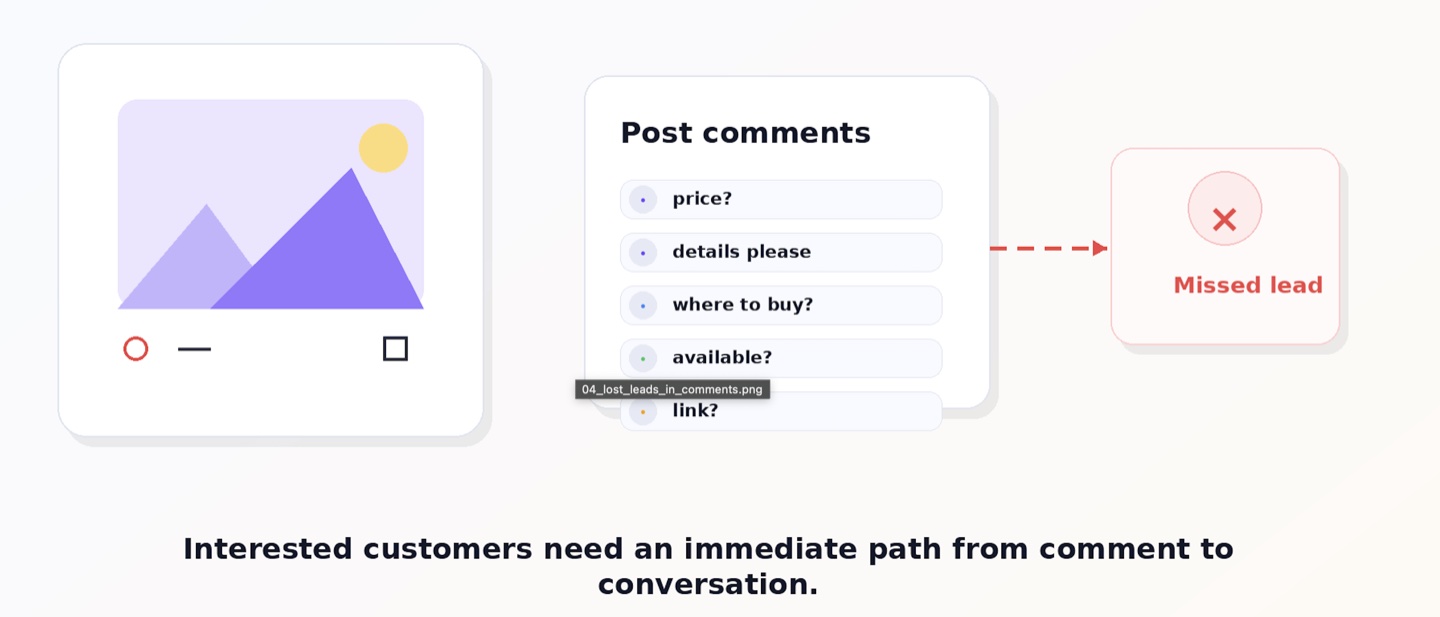
For Instagram-first businesses, comments are often the starting point of a sale.
A customer commenting “details,” “price,” “link,” or “catalogue” is already showing interest. But if the team is busy or the comment gets buried under newer activity, that lead may never become a conversation.
This is a major gap.
Businesses spend time and money creating content, running campaigns, and bringing people to their page. But the moment a customer shows interest, the follow-up still depends on manual effort.
If a lead is not moved quickly from a public comment into a private conversation, the opportunity can be lost.
The problem is not only speed. It is consistency.
Every interested comment should have a reliable next step. The customer should receive the right message, the team should know that a conversation has started, and the business should be able to follow up properly.
This is where automation becomes valuable. It helps businesses capture interest at the right moment instead of relying on someone to manually check every comment.
5. Repetitive questions slow the team down
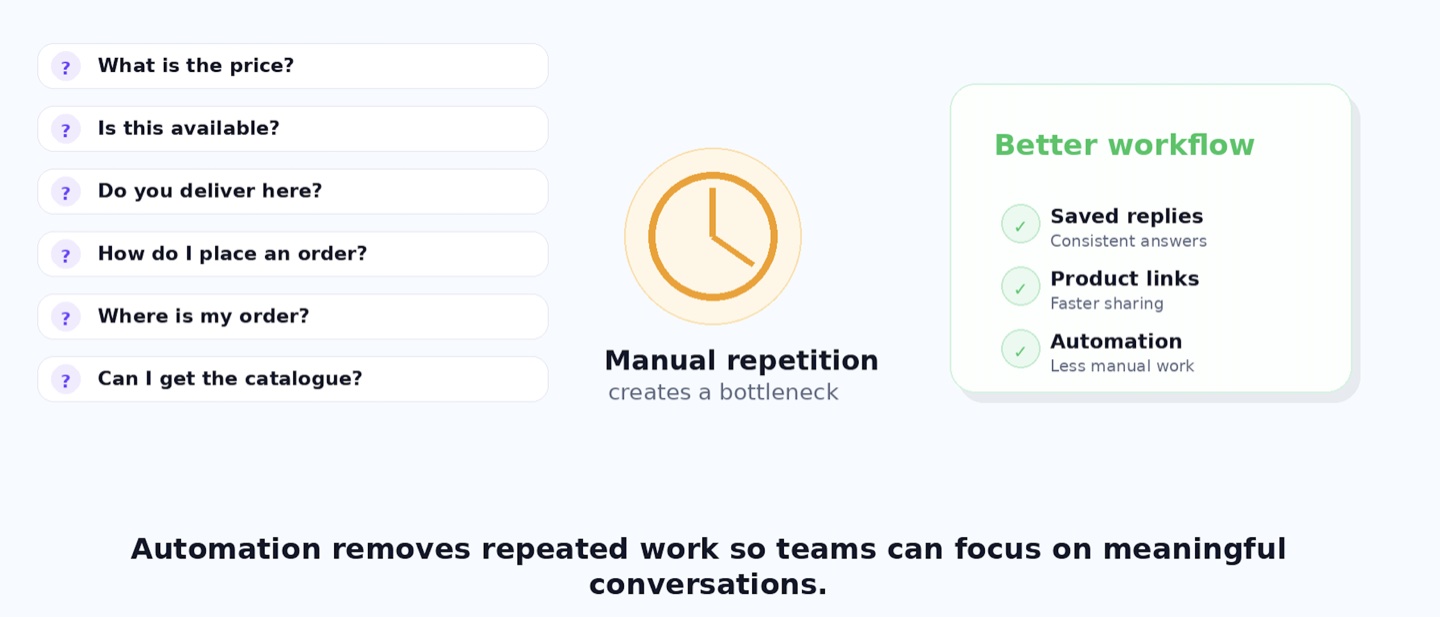
Most customer-facing teams answer the same questions every day.
Customers ask about pricing, stock availability, delivery timelines, order status, returns, bookings, product links, and catalogues. These questions are important, but they do not always require a custom response.
When agents manually type the same replies again and again, the team loses time that could be spent on higher-value conversations.
This also creates inconsistency. One agent may share a detailed answer. Another may send a shorter reply. Someone else may forget to include the right link or next step.
As message volume increases, repetition becomes a bottleneck.
The solution is not simply hiring more agents. Without better workflows, more agents can create more confusion.
Businesses need saved replies, automated responses, product links, and smart categorization so that common questions can be handled faster and more consistently.
6. Customer context gets lost
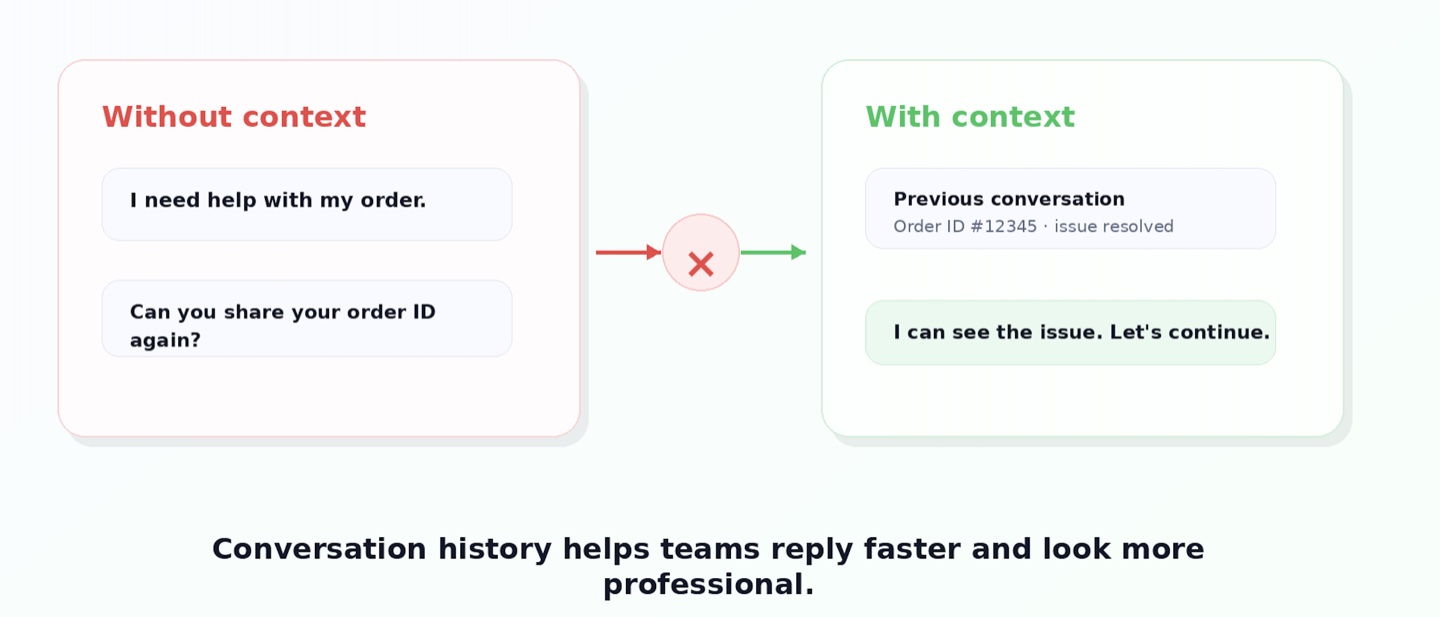
A customer conversation is not just the latest message.
It includes what the customer asked earlier, what they were interested in, whether they already received a link, whether they had a complaint, and whether someone from the team already followed up.
When context is missing, every conversation starts from zero.
The customer has to repeat themselves. The agent has to ask basic questions again. The business loses the ability to provide a smooth experience.
This is especially harmful for sales and support.
In sales, context helps the team understand buying intent. In support, context helps the team resolve issues faster. In both cases, losing context makes the business look less professional.
A proper conversation system should preserve customer history and make it easy for agents to understand what happened before they reply.
7. Managers lack visibility into what is happening
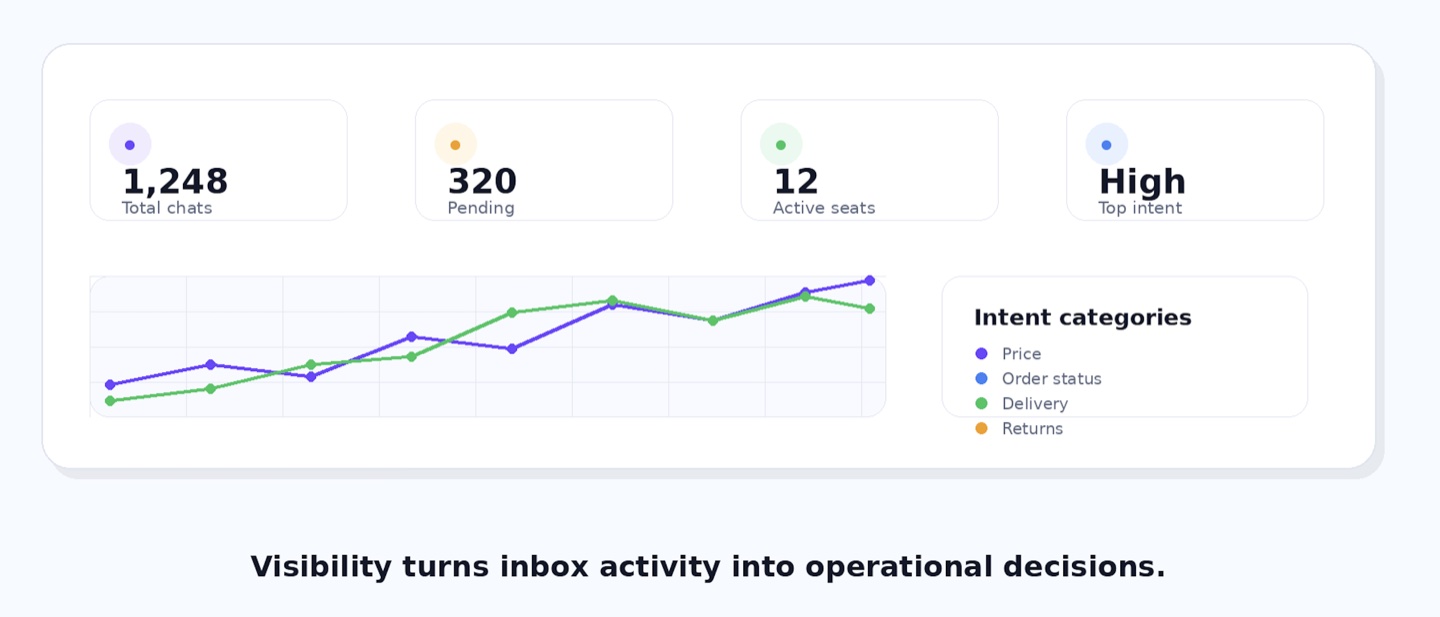
As teams grow, managers need more than access to the inbox. They need visibility.
They need to know how many conversations are coming in, what customers are asking about, which chats are pending, which agents are handling what, and where the team is getting stuck.
Without visibility, it is difficult to improve performance.
A business may not know whether most customers are asking about price, stock, delivery, returns, or order status. It may not know whether leads are being missed during busy hours. It may not know whether agents are overloaded or whether certain types of conversations need automation.
When there is no reporting or categorization, decision-making becomes reactive.
Managers only discover problems after customers complain.
A structured conversation system helps teams understand not just individual chats, but also the larger patterns behind customer communication.
Why automation is now necessary
Automation is no longer just a convenience. For growing businesses, it is becoming a requirement.
The goal of automation is not to remove people from customer conversations. The goal is to remove repetitive, manual, and error-prone work so that teams can focus on conversations that need human attention.
Automation can help businesses respond instantly to common triggers, move interested customers from comments to DMs, categorize conversations by intent, assign chats to the right agent, and make repeated replies faster.
This gives the team more control.
Instead of constantly reacting to messages, the business can build a workflow around them.
That is the shift modern teams need: from manual replying to structured conversation management.
Where Chatwise comes in
Chatwise is built to help businesses bring structure to customer conversations, especially for Instagram-first teams.
Instead of managing customer messages through shared passwords, scattered phones, and manual follow-ups, Chatwise gives teams a shared inbox where conversations can be organized, assigned, categorized, and handled more safely.
It helps businesses move from inbox chaos to a clear workflow.
Teams can capture leads from comments, manage Instagram DMs in one place, assign conversations to agents, use saved replies, and understand customer intent with AI-based categorization.
What Chatwise supports today
As of now, Chatwise supports Instagram-focused conversation workflows for growing teams.
It supports:
- Instagram shared inbox for teams
- Comment-to-DM automation
- Multi-agent access without sharing the main Instagram password
- Auto chat assignment
- AI-based chat categorization
- Saved replies and product links
- Mobile-friendly workflows for agents
We are currently building WhatsApp shared inbox support.
The future of business conversations
Customer conversations are no longer just messages inside an app.
They are sales opportunities, support requests, customer history, team workflows, and business data. Treating them casually leads to missed leads, delayed replies, security risks, and poor customer experience.
Growing businesses need to manage conversations with the same seriousness as they manage orders, payments, inventory, or customer records.
That means conversations need structure.
They need ownership.
They need automation.
They need accountability.
They need context.
They need visibility.
Chatwise is built around this shift.
It helps teams move away from scattered, manual, and risky inbox management toward a more organized way of handling customer conversations.
Because for modern businesses, conversations are not just where customers ask questions.
They are where business happens.
DID THIS RESONATE?
A little encouragement.
If something here stayed with you, leave a clap.
— claps
A little encouragement goes a long way.
KEEP THE CONVERSATION GOING
What’s on your mind?
A question, a different perspective, or a story of your own. I’d love to hear it.
The conversation
Loading the conversation…