Building Growth Systems for Modern Brands
In my last post, I wrote about how I came to build Haulistic and Chatwise.
That story started with a simple observation.
A lot of modern brands are already doing the hard part.
They are creating good products.
Building trust with their audience.
Showing up consistently on Instagram.
Talking to customers every day.
Trying to figure things out with limited time and small teams.
But the more time I spend working with brands, the more I realise that growth becomes difficult when everything is treated separately.
A brand may be improving its website, running ads, posting content, replying to customers, and trying to increase repeat purchases — all at the same time.
But unless these pieces are connected, it can still feel scattered.
That is the shift I’ve been thinking about recently.
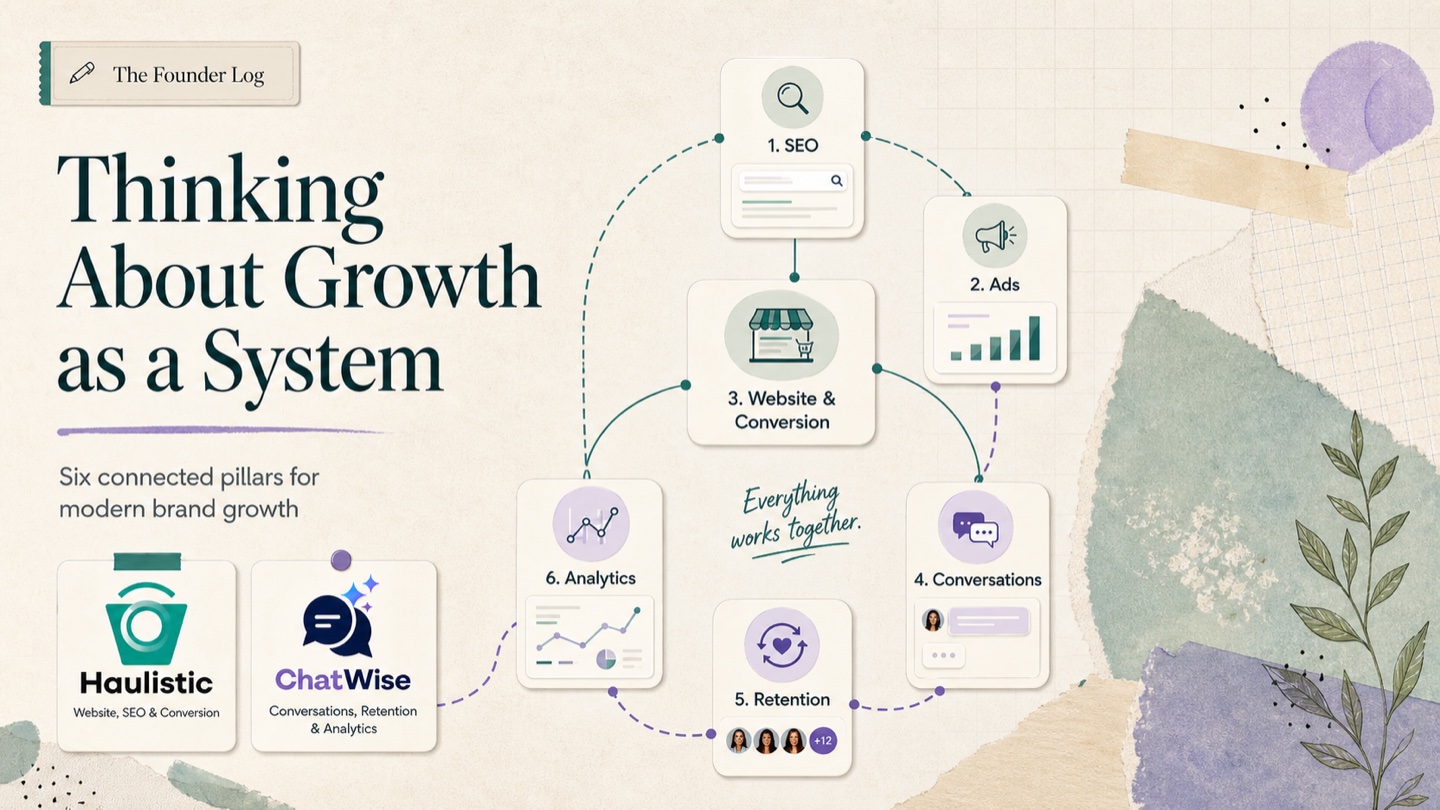
Growth starts to make more sense when it is treated as a system.
Not one campaign.
Not one channel.
Not one tool.
A system where discovery, conversion, conversations, retention, and analytics support each other.
The six pillars I keep coming back to
Right now, I find myself thinking about brand growth across six pillars.
SEO.
Ads.
Website performance and conversion.
Conversations.
Retention.
Analytics.
These are not separate boxes for me.
They are connected parts of the same journey.
A customer has to discover the brand, understand the product, trust the experience, ask questions if needed, complete the purchase, and hopefully come back again.
And at every stage, the brand needs to understand what is working and what is not.
That is the larger picture I’m trying to build around.
SEO
SEO is about being discoverable.
For a lot of small brands, Instagram is the main discovery channel. And that makes sense. It is visual, personal, and very effective for building trust.
But I also think brands need assets outside social media.
A good product page can bring traffic.
A useful blog can answer customer questions.
A collection page can help people discover products through search.
A well-structured website can keep working even when the brand is not actively posting.
SEO is not always instant.
It does not give the same quick feedback as ads or reels.
But over time, it can become one of the strongest channels for a brand — especially if the brand is building something specific, thoughtful, or search-driven.
Ads
Ads are the faster side of growth.
They help brands test offers, reach new audiences, retarget visitors, and understand what kind of messaging works.
But I don’t think ads should be looked at only as a way to bring traffic.
They are also a way to understand the market faster.
When people start clicking, browsing, asking questions, or dropping off, there is a lot to learn.
Sometimes the offer needs to be clearer.
Sometimes the product page needs more trust.
Sometimes the audience is right, but the journey after the click is not strong enough yet.
That is why I think ads work best when they are connected to the website, conversations, analytics, and retention — not treated as a separate activity.
Website performance and conversion
This is the area that connects most closely to Haulistic.
A website should not just exist.
It should make buying easier.
A customer should be able to land on the site and quickly understand what the brand sells, what makes the product worth buying, how to place an order, and whether they can trust the brand.
For many Instagram-first brands, this is where things start becoming messy.
The products are good.
The content is good.
The customer interest is there.
But the buying experience is not always smooth.
Sometimes there is no proper website. Sometimes the website exists, but the product pages are not strong enough. Sometimes customers still have to ask basic questions in DMs before they feel ready to buy.
This is why I care about website performance and conversion so much.
Because once a brand is already getting attention, even small improvements here can make a real difference.
Conversations
This is the area I keep coming back to the most.
Because for many modern brands, a big part of the customer journey does not happen only on the website. It happens in conversations.
Before a customer buys, they may want to ask something. They may need help choosing the right product, understanding availability, checking delivery timelines, or simply feeling more confident about the brand.
And a lot of this happens on Instagram and WhatsApp.
At first, this can feel manageable. The founder replies directly, remembers regular customers, and handles things personally.
But as the brand grows, the same personal experience becomes harder to maintain.
Messages come in from different places. Some are sales-related, some are support-related, some are order-related, and some are just general questions.
When there is no structure around this, it becomes easy to miss conversations or lose context.
That is what made me think about conversations as a separate growth pillar.
Because conversations are not just a support function. They influence trust, conversion, retention, and the overall customer experience.
This is where Chatwise fits in.
The idea is to help brands bring more clarity to their customer conversations — to understand what customers are asking, keep track of open conversations, support teams better, and make sure important messages do not get buried.
For me, the goal is not to make brand communication feel less human.
It is the opposite.
The goal is to help brands stay personal even as they grow.
Retention
Growth is not only about getting new customers.
It is also about what happens after someone buys for the first time.
This is something I think many small brands can improve with the right systems.
A lot of them already have happy customers. But after the first order, the relationship often becomes quiet.
The customer receives the product, maybe shares feedback, maybe likes the experience — but unless the brand has a way to continue that relationship, the next purchase is left to chance.
Retention does not always have to mean complicated campaigns.
Sometimes it is as simple as better post-purchase communication, helpful updates, timely reminders, product recommendations, or making the customer feel remembered.
For me, this connects closely to both Haulistic and Chatwise.
Haulistic helps create a smoother buying experience.
Chatwise helps continue the relationship through better conversations.
And over time, I think retention will become one of the most important areas for the kind of brands we want to work with.
Because strong brands are not built only by getting attention once.
They are built by creating enough trust for customers to come back.
Analytics
The last pillar is analytics.
And I think this is the one that quietly holds everything together.
Without analytics, it is very hard to know what is actually working.
A brand may feel like Instagram is working, but not know which posts lead to sales.
An ad may bring traffic, but not enough conversions.
A website may get visitors, but people may be dropping off at a specific point.
A lot of conversations may be happening, but the brand may not know what customers are asking most often.
Analytics helps bring clarity.
It does not solve everything by itself.
But it helps brands make better decisions.
And for me, that is very important because growth should not be based only on guesswork.
Where Haulistic fits in
When I look at these six pillars, Haulistic connects most closely with the website layer of growth.
At its core, it is about helping brands create a proper ecommerce storefront — not just a page that looks good, but a place where customers can browse, understand the products, trust the brand, and buy without unnecessary friction.
For Instagram-first brands, this is an important shift.
A lot of these brands already have attention. People are discovering them through reels, stories, posts, and ads.
But once a customer is interested, the buying experience needs to support that interest properly.
That is where the website starts doing more of the work.
It helps present products clearly.
It gives the brand a more structured presence.
It supports SEO and organic discovery.
It makes the customer journey smoother.
It also connects closely with ads and analytics.
If a brand is running Meta Ads or other campaigns, the website needs to send the right signals back — what people viewed, what they added to cart, what they purchased, and where they dropped off.
Without that, ads become harder to optimise.
So for me, Haulistic is not only about building a storefront. It is also about building the foundation around it — conversion, tracking, product discovery, and the data brands need to grow better.
Where Chatwise fits in
Chatwise sits around conversations, retention, analytics, and even ads in some ways.
Because a lot of ad-driven and social-driven interest eventually turns into conversations.
People ask questions before buying.
They comment before they trust.
They DM before they decide.
If those conversations are not managed well, growth leaks.
Chatwise is our attempt to bring structure to that layer.
To help brands manage DMs and comments better.
To help teams know what is happening.
To reduce missed messages.
To understand customer intent.
To make replies faster and more consistent.
In the long run, I think conversations will become one of the most important parts of commerce.
Not just because customers need support.
But because conversations are where trust is built.
What I’m learning
The more I work on this, the more I realise that brands do not always need everything at once.
Some brands need more traffic.
Some already have traffic, but need better conversion.
Some are getting sales, but losing customers after the first purchase.
Some are growing on Instagram, but struggling to manage the conversations that come with it.
Some are doing many things, but do not have clear data on what is actually working.
So the priority changes depending on the stage of the brand.
But the larger system remains the same.
Discovery.
Traffic.
Conversion.
Conversations.
Retention.
Analytics.
Where I want to go from here
I think this is also shaping how I want to build.
Haulistic and Chatwise are not random products for me.
They are both connected to the same larger idea.
Modern brands need better systems to sell, communicate, understand customers, and grow consistently.
Not just more tools.
Not just more dashboards.
Not just more features.
Better systems.
That is what I’m trying to understand more deeply.
And that is what I’ll keep writing about here.
This is still early, and I’m still learning a lot from every brand we work with.
But this six-pillar view is becoming the foundation for how I think about growth — and how I want to build products around it.
DID THIS RESONATE?
A little encouragement.
If something here stayed with you, leave a clap.
— claps
A little encouragement goes a long way.
KEEP THE CONVERSATION GOING
What’s on your mind?
A question, a different perspective, or a story of your own. I’d love to hear it.
The conversation
Loading the conversation…