the journey so far…
Hi, I’m Maria.
I spend most of my time these days building tools for brands and trying to understand what actually helps them grow.
Over time, this has turned into a journey of its own — one that I’ve been meaning to pause and put into words for a while now. This is a small attempt to document that journey so far, along with the thoughts and things I’ve been learning along the way.
Where I started
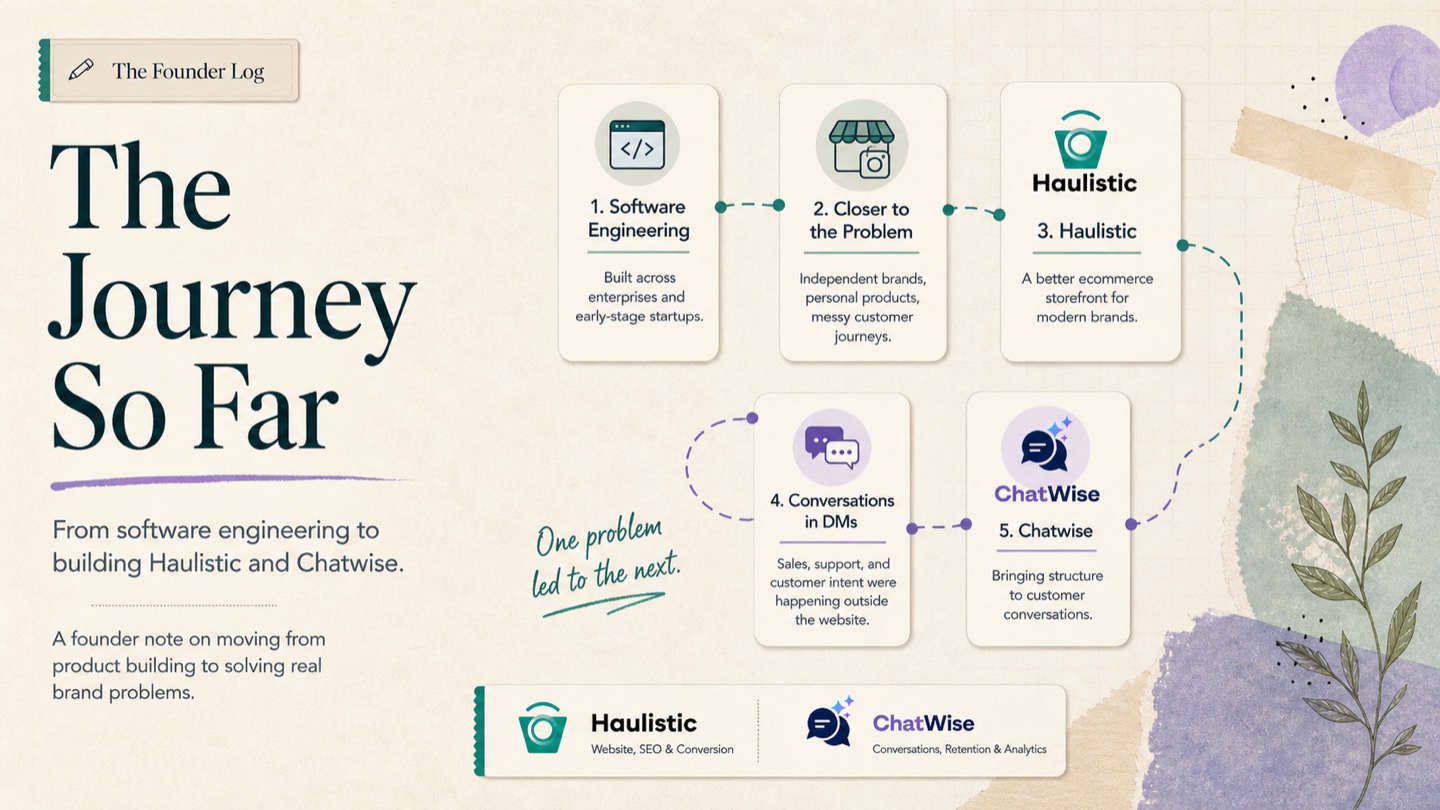
Over the years, I’ve worked as a software engineer across both large enterprises and early-stage startups.
A lot of that time was spent building products — solving problems at scale, working with teams, shipping things. It was fast-paced, structured, and in many ways, exactly what I had set out to do.
But somewhere along the way, I started feeling a pull towards something else.
I wanted to build more independently.
To be closer to the problems I was working on.
To see things through end-to-end, instead of just a small part of the system.
It wasn’t a sudden decision — more like something that kept coming back in the background.
Getting closer to the problem
Around the same time, I found myself interacting more with a new set of brands — especially early-stage, independent ones growing on Instagram.
There was a lot to like about them.
The products felt thoughtful.
The branding felt personal.
You could see the effort behind what they were building.
But the experience around it often felt inconsistent.
Sometimes there was no proper website.
Sometimes the website existed, but didn’t quite do its job.
A lot of conversations happened over DMs.
And many things seemed to depend on the founder manually holding it all together.
It wasn’t one big issue.
It was a lot of small things that didn’t quite connect.
Starting to build
That’s where I started.
We built Haulistic to help brands set up their website and sell online in a more structured way.
It was a clear problem, and it helped.
But while working on this, something else became harder to ignore.
A significant portion of customer interaction was still happening outside the website.
It was happening in DMs — primarily on Instagram and WhatsApp.
What was happening in DMs
Most of these brands were actively talking to their customers on Instagram and WhatsApp.
People asking about products.
Checking availability.
Clarifying details before making a purchase.
For some brands, this meant handling hundreds of messages a day. In a few cases, even 500+ DMs on Instagram alone.
And there was very little structure around it.
Messages got missed.
Replies were delayed.
Teams didn’t always know who had responded to what.
From the outside, it didn’t look like a major issue.
But from the inside, it felt chaotic.
And more importantly, it was affecting sales.
Building further
That’s what led us to build Chatwise.
Not as something completely new, but as a way to bring some structure to these conversations.
To make them easier to manage.
To reduce the dependency on one person.
To help teams respond more consistently.
Over time, we also started layering in a few things that felt necessary at scale.
Things like automatically moving comments into DMs, so conversations don’t get missed.
Using AI to help organise chats — categorising them, surfacing intent.
And even assisting with replies, so most replies can be automated without waiting on a human to respond to them.
We’re still early with a few live customers, but it’s been interesting to see how much of a difference this layer makes.
Where things are today
Over time, it became difficult to look at any one part of growth in isolation.
The website matters.
But so do conversations.
Discovery, marketing, retention — everything is connected in some way.
Because of this, we’ve also started working more closely with a small number of brands.
We’re intentionally keeping this limited — working with a few handpicked brands, where we can support them more closely across different parts of their growth.
Not just one piece, but end-to-end.
What I’m exploring next
Right now, I’ve been thinking about growth more as a system than a single function.
A few core pieces that need to work together — even if they’re often treated separately.
I’ll be writing more about this in the next few posts.
If you’re building a brand and navigating some of these problems, I’d love to hear how you’re thinking about it.
DID THIS RESONATE?
A little encouragement.
If something here stayed with you, leave a clap.
— claps
A little encouragement goes a long way.
KEEP THE CONVERSATION GOING
What’s on your mind?
A question, a different perspective, or a story of your own. I’d love to hear it.
The conversation
Loading the conversation…